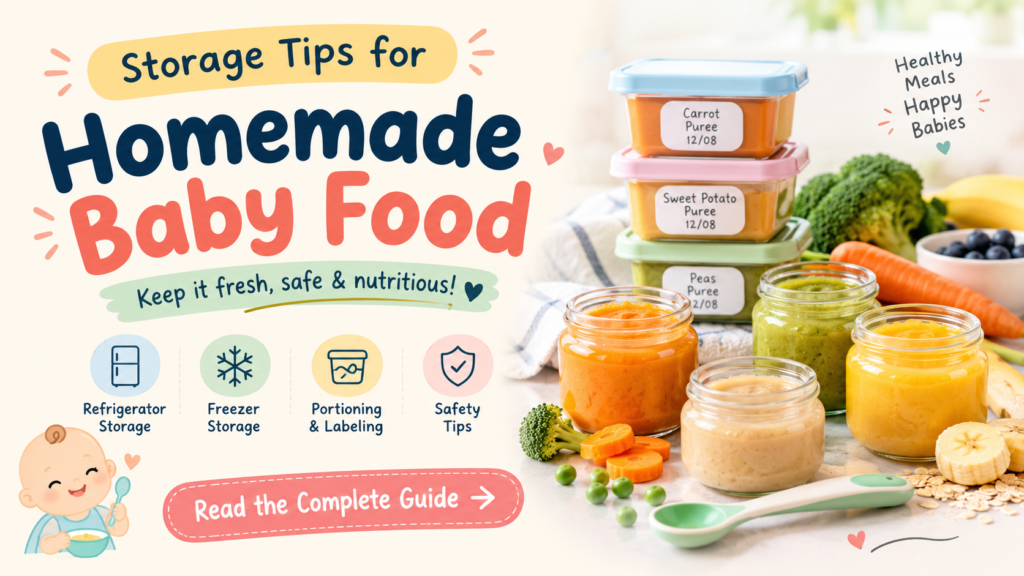
Making homemade baby food can be a wonderful way to introduce your little one to different flavors, textures, fruits, vegetables, grains, and other nutritious foods. It can also make mealtimes easier because you can prepare small portions ahead of time and have them ready when your baby is hungry.
But once you’ve prepared homemade baby food, an important question comes up:
How should you store it, and how long is homemade baby food safe to eat?
Proper storage is just as important as choosing fresh ingredients and preparing food carefully. Babies and young children are more vulnerable to certain foodborne illnesses, so parents need to pay close attention to cleanliness, temperature, storage containers, and how long food has been kept.
In this guide, you’ll learn how to store homemade baby food in the refrigerator and freezer, how to thaw and reheat it safely, which storage mistakes to avoid, and how to organize baby food for easy everyday meals.
Important: This guide is for homemade complementary foods such as purées, mashed fruits and vegetables, and age-appropriate cooked foods. Homemade infant formula is different and should not be prepared at home; the FDA advises parents and caregivers not to make homemade infant formula.
Table of Contents
Why Proper Baby Food Storage Matters
Homemade baby food does not contain the same commercial preservation and processing controls found in many packaged baby foods. Once food has been cooked, mashed, or puréed, it can become a good environment for bacteria if it is handled or stored incorrectly.
Keeping baby food at safe temperatures slows bacterial growth and helps maintain food quality.
FoodSafety.gov recommends keeping the refrigerator at 40°F (4°C) or below and the freezer at 0°F (-18°C) or below.
Because babies have developing immune systems, it’s better to be cautious with homemade food storage. If you are unsure how long something has been stored or whether it was kept at a safe temperature, throw it away rather than taking a chance.
Storage Tips for Homemade Baby Food
1. Wash Your Hands Before Preparing Baby Food
Safe storage starts before the food even reaches the refrigerator.
Wash your hands thoroughly with soap and water before:
- Preparing baby food
- Handling cooked ingredients
- Filling storage containers
- Serving food
- Handling utensils
Clean your countertops, cutting boards, knives, blender, food processor, and other utensils that come into contact with your baby’s food.
It’s also important to use clean storage containers with properly fitting lids.
Remember that food can become contaminated during preparation, so good kitchen hygiene is an important part of baby food safety.
2. Cook Ingredients Thoroughly
When making homemade baby food, prepare ingredients according to your baby’s developmental stage.
Fruits and vegetables that are hard should generally be cooked until they are soft enough to mash or purée easily.
For foods such as meat, poultry, fish, and eggs, cook them thoroughly and remove bones, skin, and other unsafe pieces before preparing the food for your baby.
The CDC recommends preparing foods in textures appropriate for your baby’s development and making hard foods soft enough to mash or purée.
Once the food is prepared, don’t leave it sitting on the kitchen counter for a long time.
3. Cool Homemade Baby Food Quickly
One common mistake parents make is leaving freshly prepared baby food at room temperature for too long.
Perishable foods should be refrigerated or frozen promptly. FoodSafety.gov recommends refrigerating perishable foods within 2 hours, or within 1 hour when temperatures are above 90°F (32°C).
Instead of keeping a large pot of purée warm for a long time, divide it into smaller portions so it can cool and be refrigerated efficiently.
Small portions are also easier to use later.
4. Use Small, Airtight Containers
Small containers are ideal for homemade baby food because they make portioning easier and reduce unnecessary exposure to air.
Look for containers that are:
- Food-safe
- Clean
- Leak-resistant
- Easy to wash
- Suitable for refrigeration or freezing
- Clearly labeled
You can portion food according to how much your baby usually eats.
For example, instead of storing a large container of sweet potato purée, divide it into several small portions.
This way, you only take out what you need.
5. Label Every Container
One of the easiest ways to lose track of baby food is to put containers in the refrigerator or freezer without labels.
Before storing homemade baby food, write:
Food name + preparation date
For example:
Sweet Potato Purée – Sept. 5
For freezer portions, you can also write the date you froze the food.
This simple habit helps you use older portions first and avoid guessing how long something has been stored.
6. How Long Can Homemade Baby Food Stay in the Refrigerator?
This is one of the most important questions for parents.
Current FoodSafety.gov guidance lists homemade baby foods as 1–2 days in the refrigerator. The refrigerator should be maintained at 40°F (4°C) or below.
For specific categories, the guidance lists:
| Homemade Baby Food | Refrigerator |
|---|---|
| Homemade baby foods | 1–2 days |
| Strained fruits & vegetables | 2–3 days |
| Strained meats & eggs | 1 day |
| Meat & vegetable combinations | 1–2 days |
When preparing food specifically for your baby, following the shorter storage window can be a simple way to reduce unnecessary risk.
If you know you won’t use the food within the recommended refrigerator window, freezing it can be a better option.
7. Freezing Homemade Baby Food
Freezing is one of the most convenient ways to prepare homemade baby food ahead of time.
You can make a batch of baby-friendly food, divide it into small portions, freeze it, and then thaw only what your baby needs.
FoodSafety.gov lists 1–2 months for homemade baby foods in the freezer.
For specific foods, storage guidance can vary. For example, strained fruits and vegetables may have a longer freezer quality window, while strained meats and eggs have shorter recommended storage times.
When freezing baby food, it’s best to follow the storage recommendation for the specific food you’re preparing.
8. Try the Ice Cube Tray Method
An ice cube tray can make portioning homemade baby food extremely convenient.
Here’s a simple method:
- Prepare the baby food.
- Allow it to cool appropriately.
- Spoon it into a clean ice cube tray.
- Cover the tray appropriately.
- Freeze until solid.
- Transfer the frozen portions into a labeled freezer-safe container or bag.
- Write the food name and date on the container.
The FDA specifically describes freezing homemade baby food in ice cube trays as an option and recommends transferring frozen cubes to a freezer bag or airtight container and dating them.
Each cube can provide a convenient small portion, especially when your baby is just beginning solids.
9. Store Food in Single-Serving Portions
Freezing food in small portions has another major advantage: you don’t have to thaw the entire batch.
For example, you could freeze:
- Carrot purée
- Pumpkin purée
- Sweet potato
- Pear purée
- Apple purée
- Mashed peas
- Cooked grain mixtures
Then take out only the amount needed for one meal.
This reduces food waste and makes busy mealtimes much easier.
10. Never Refreeze Previously Thawed Baby Food Without Checking Safety Guidance
Once food has been thawed, don’t automatically put it back into the freezer.
A safer routine is:
Freeze → thaw → use
rather than repeatedly freezing and thawing the same portion.
For the best quality and safety, thaw frozen baby food in the refrigerator, rather than leaving it on the kitchen counter.
FoodSafety.gov recommends thawing frozen food safely in the refrigerator, cold water, or microwave rather than on the counter.
11. How to Thaw Homemade Baby Food Safely
There are several ways to thaw frozen baby food.
Refrigerator Method
Move the frozen portion from the freezer to the refrigerator and allow it to thaw there.
This is a simple option when you know what your baby will eat the following day.
Microwave Method
If using a microwave, transfer the food to a microwave-safe dish rather than heating baby food in its storage jar.
The FDA recommends stirring microwaved baby food, allowing it to stand, and checking the temperature before feeding because microwaves can create hot spots.
Warm Water Method
Some parents prefer placing a sealed container of frozen food in warm water to help it thaw.
Whatever method you use, make sure the food is heated evenly and test it before giving it to your baby.
12. Always Check the Temperature Before Feeding
Baby food should never be served extremely hot.
After reheating:
- Stir thoroughly.
- Let the food stand briefly.
- Check the temperature.
- Make sure there are no hot spots.
- Feed only when it is comfortably warm.
The FDA recommends stirring heated baby food, allowing it to stand, and checking the temperature before feeding.
13. Don’t Feed Your Baby Directly From the Storage Container
This is an important storage habit.
Instead of putting the storage container directly in front of your baby and allowing them to eat from it, take the portion you expect them to eat and place it in a separate bowl.
Why?
Once a spoon has gone from your baby’s mouth back into the food container, saliva can introduce bacteria into the remaining food.
By serving a separate portion, you can keep the unused food cleaner and reduce contamination.
The FDA specifically advises against returning baby food to the refrigerator after a baby has eaten directly from the container.
14. What Should You Do With Leftover Baby Food?
If your baby has already eaten from a bowl, don’t automatically put the leftovers back into the refrigerator.
The safest approach is to serve small portions and add more as needed.
This is especially helpful for babies who are just starting solids and may eat only a few spoonfuls.
Instead of putting a large portion in front of your baby, start small and add more if your baby is still hungry.
This can reduce food waste and make feeding more hygienic.
15. Keep Your Refrigerator at the Right Temperature
Your refrigerator should stay at 40°F (4°C) or below. Your freezer should be at 0°F (-18°C) or below.
If possible, use an appliance thermometer rather than relying only on the refrigerator’s temperature display.
Avoid storing perishable baby food in the refrigerator door because temperatures there can fluctuate more than inside the main compartment.
A middle or rear shelf is generally a better choice for keeping temperature-sensitive food consistently cold.
16. Organize Your Freezer for Easy Baby Meals
A little organization can make homemade baby food preparation much easier.
Try creating a small freezer section for baby food.
You can organize portions by:
Fruits
- Pear
- Apple
- Banana-based mixtures
- Peach
Vegetables
- Carrot
- Pumpkin
- Sweet potato
- Peas
Grains
- Oatmeal
- Rice-based mixtures
- Other age-appropriate cooked grains
Protein Foods
- Properly cooked and puréed meat
- Egg preparations appropriate for your baby’s age and development
Label everything clearly and use older portions first.
17. Don’t Rely on Smell or Appearance Alone
One important food-safety rule is that food can sometimes be unsafe even when it looks, smells, or tastes normal.
If you’re unsure how long baby food has been sitting out or whether it was stored properly, don’t taste it to determine whether it is safe.
When in doubt:
Throw it out.
This is especially important for infants and young children.
18. Avoid the Two-Hour Mistake
Busy parents sometimes prepare baby food and forget to refrigerate it.
Try to remember the basic rule:
Don’t leave perishable baby food at room temperature for more than 2 hours.
If the surrounding temperature is above 90°F (32°C), the recommended limit is 1 hour.
This is particularly important during summer, travel, outdoor meals, and power interruptions.
19. Use a Cooler When Traveling
Homemade baby food can be taken outside, but it needs to stay cold.
When traveling, use:
- An insulated cooler
- Frozen ice packs
- Leak-proof containers
- A separate spoon for serving
The FDA recommends transporting perishable baby food in an insulated cooler and not using food that has been without a cold source for more than two hours.
Never leave baby food sitting inside a hot car.
20. Don’t Overfill Your Refrigerator
An overcrowded refrigerator can make it harder for cool air to circulate properly.
Keep enough space around containers so cold air can move around the refrigerator.
Check that the refrigerator door closes properly and avoid leaving it open unnecessarily.
These small habits help maintain a more stable temperature.
Common Baby Food Storage Mistakes to Avoid
Even when parents have good intentions, a few common mistakes can create unnecessary food-safety risks.
Avoid:
❌ Leaving homemade baby food on the counter for hours
❌ Storing food without a preparation date
❌ Using containers that aren’t clean
❌ Feeding directly from the main storage container
❌ Putting partially eaten food back into the refrigerator
❌ Thawing food on the kitchen counter
❌ Repeatedly heating and cooling the same portion
❌ Keeping homemade baby food longer than recommended
❌ Guessing whether old food is safe based only on smell
❌ Leaving perishable baby food in a hot car
A Simple Homemade Baby Food Storage Routine
If you’re looking for an easy routine, try this:
Step 1: Prepare
Wash your hands, ingredients, utensils, and work surfaces.
Step 2: Cook
Cook foods until they are appropriately soft and safely cooked.
Step 3: Portion
Divide the food into small serving portions.
Step 4: Label
Write the food name and preparation date on each container.
Step 5: Refrigerate or Freeze
Refrigerate food you’ll use soon. Freeze portions you won’t use within the recommended refrigerator storage period.
Step 6: Thaw Safely
Thaw frozen portions in the refrigerator or use another safe thawing method.
Step 7: Reheat Carefully
Warm the portion evenly and check the temperature.
Step 8: Serve
Put the amount your baby is likely to eat into a separate bowl.
Step 9: Discard Leftovers
Don’t return food that has been exposed to your baby’s saliva to the storage container.
This simple system can make homemade baby food preparation safer and much less stressful.
Quick Homemade Baby Food Storage Chart
Keep this simple chart handy:
| Food | Refrigerator | Freezer |
|---|---|---|
| Homemade baby food | 1–2 days | 1–2 months |
| Strained fruits & vegetables | 2–3 days | 6–8 months |
| Strained meats & eggs | 1 day | 1–2 months |
| Meat & vegetable combinations | 1–2 days | 1–2 months |
These are current FoodSafety.gov recommendations for opened or freshly made purées and solid baby foods.
Always consider the specific ingredients in a recipe and use the more conservative storage time when you’re unsure.
read our – Baby Feeding Guide for Beginners
Final Thoughts
Homemade baby food can make introducing solids easier, more affordable, and enjoyable, but safe storage should always be part of your preparation routine.
The most important habits are simple:
Keep food clean. Keep it cold. Portion it wisely. Label it. Don’t keep it too long.
For refrigerator storage, current FoodSafety.gov guidance recommends 1–2 days for homemade baby foods, while freezer recommendations depend on the type of food.
If you’re preparing baby food in batches, freezing small portions can be especially convenient. It allows you to prepare ahead without keeping large amounts of food in the refrigerator.
And remember: when you’re unsure whether a particular portion is safe, it’s better to throw it away than risk your baby’s health.
As your baby grows and moves from smooth purées toward mashed, lumpy, and finger foods, continue following age-appropriate food preparation and choking-safety recommendations. The CDC recommends choosing textures appropriate to your baby’s developmental abilities and always supervising your child while eating.
A little planning and a few good storage habits can make homemade baby food both convenient and safer for your little one. 💛
This article provides general food-safety information and is not a substitute for advice from your pediatrician or other qualified healthcare professional. If your baby is unwell after eating or you have concerns about a particular food, contact your healthcare provider.
Explore More By Categories
- Baby care tips
- Baby Essentials
- Baby Feeding Guide
- Baby Names
- Healthy Racipe for mom
- Kids Birthday Ideas
- Kids Meal Ideas & Food Recipes
- Kids Songs, Rhymes & Stories
- Postpartum Care
- Toddler Learning & Daily Skills
You May Also Like this
- Storage Tips for Homemade Baby Food: A Safe & Easy Guide for Parents
- 100+ Cultural & Modern Dhanu Rashi Baby Boy Names With Wonderful Meanings

- 20 Classic Nursery Rhymes For Toddlers : Every Toddler Should Know
- 35 Fun Rainy Day Activities for Toddlers to Keep Them Busy & Learning
- 100+ Cultural and Religious Dhanu (Sagittarius) Rashi Baby Girl Names With Meanings

- 15 Easy Lunchbox Ideas for Picky Eaters That Kids Will Actually Eat