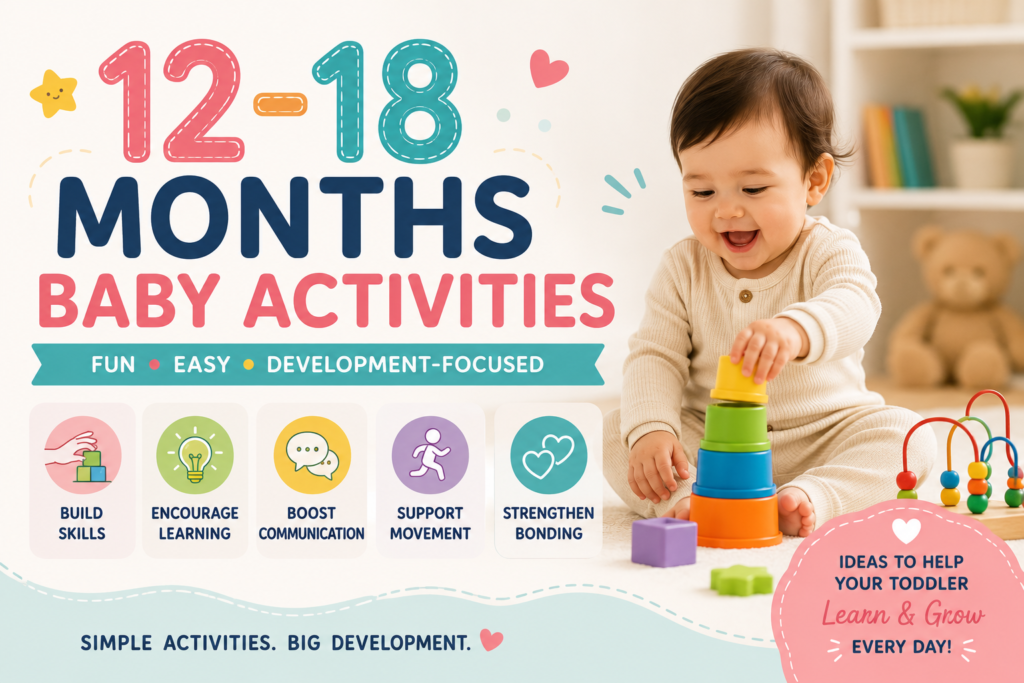
Toddlers between 12 and 18 months grow incredibly fast. One day they’re taking their first steps, and the next they’re exploring every corner of the house with endless curiosity.
At this stage, babies learn best through simple everyday activities and play. The right activities can help support:
- Motor skills
- Speech development
- Sensory learning
- Hand-eye coordination
- Social and emotional growth
The good news?
You don’t need expensive toys or complicated setups.
In this guide, you’ll discover fun, simple, and development-friendly 12–18 months baby activities you can easily do at home.
Table of Contents
👶 Why 12–18 Months Baby Activities Matter
Between 12 and 18 months, toddlers are learning rapidly through movement, repetition, and exploration.
Simple activities help babies:
- Build confidence
- Improve balance and coordination
- Learn problem-solving
- Develop communication skills
- Stay mentally stimulated
Play is not just entertainment—it’s how toddlers learn best.
🎯 Best 12–18 Months Baby Activities
1. Stacking Cups or Blocks
This simple activity improves:
✔ Fine motor skills
✔ Hand-eye coordination
✔ Problem-solving
Your toddler will enjoy:
- Stacking
- Knocking towers down
- Rebuilding again and again
👉 Repetition is completely normal at this age.
2. Sensory Bin Play
Create a simple sensory bin using:
- Dry pasta
- Rice
- Large pom-poms
- Soft fabric pieces
Always supervise closely.
Sensory play helps toddlers explore textures, sounds, and movement.
3. Reading Picture Books 📚
Reading daily supports:
- Language development
- Listening skills
- Emotional bonding
Choose books with:
- Bright pictures
- Simple words
- Animal sounds
- Lift-the-flap features
👉 Repetition helps speech learning.
4. Dancing to Music 🎵
Music activities improve:
- Movement coordination
- Rhythm awareness
- Emotional expression
Play gentle nursery songs and encourage:
- Clapping
- Swaying
- Simple dancing
Toddlers love interactive music time.
5. Ball Rolling Games ⚽
Sit on the floor and roll a soft ball back and forth.
This activity supports:
- Coordination
- Turn-taking
- Social interaction
Simple games are often the most engaging.
6. Water Play 💦
Toddlers love water exploration.
Easy ideas:
- Pouring cups
- Floating toys
- Splashing gently
Water play improves sensory development and fine motor skills.
⚠️ Always supervise closely.
7. Shape Sorting Toys
Shape sorters help toddlers learn:
- Problem-solving
- Spatial awareness
- Matching skills
At this age, babies may not complete shapes perfectly—and that’s okay.
8. Sticker Fun
Large stickers are great for:
✔ Finger control
✔ Concentration
✔ Creativity
Let toddlers stick them on:
- Paper
- Cardboard
- Safe surfaces
Simple activities keep toddlers engaged longer.
9. Pretend Play 🧸
Toddlers begin imitating adults around this age.
Fun pretend play ideas:
- Feeding stuffed animals
- Talking on toy phones
- Pretend cooking
Pretend play supports imagination and communication.
10. Obstacle Course for Toddlers
Use pillows and cushions to create safe movement challenges.
This helps develop:
- Balance
- Coordination
- Gross motor skills
Keep it soft and age-appropriate.
11. Simple Art Activities 🎨
Toddlers enjoy creative exploration.
Try:
- Washable crayons
- Finger painting
- Dot markers
Art supports creativity and sensory learning.
12. Naming Everyday Objects
Point to objects throughout the day:
- “Ball”
- “Dog”
- “Cup”
This builds vocabulary naturally.
👉 Everyday conversation matters more than perfection.
13. Bubble Play 🫧
Bubbles are fantastic for:
- Visual tracking
- Hand coordination
- Excitement and movement
Toddlers love chasing and popping bubbles.
14. Laundry Basket Push Game
A laundry basket can become a fun push toy.
Benefits include:
✔ Walking confidence
✔ Balance practice
✔ Muscle development
Perfect for early walkers.
15. Nature Walks 🌿
Take short outdoor walks and explore:
- Leaves
- Birds
- Flowers
- Sounds
Outdoor exploration supports sensory development and curiosity.
🧠 Development Skills These Activities Support
These activities help strengthen:
- Gross motor skills
- Fine motor skills
- Speech development
- Emotional growth
- Social interaction
- Sensory exploration
Simple daily play creates meaningful learning opportunities.
💡 Tips for Playing With Toddlers (12–18 Months)
Toddler playtime can sometimes feel messy, repetitive, or chaotic — and that’s completely normal. Toddlers are still learning how the world works, so simple repeated actions are part of healthy development.
Try to avoid correcting every little thing during play. Instead, allow your toddler to explore safely and independently whenever possible. Activities should feel enjoyable and pressure-free.
It’s also important to follow your child’s energy and mood. Some days toddlers may want active movement games, while other days they prefer books, cuddles, or quiet sensory play. Flexibility helps create a more positive play experience.
Remember that toddlers learn best through interaction. Talking, smiling, singing, and responding during play helps strengthen emotional bonding and communication skills.
Most importantly, don’t compare your toddler to others. Every child develops at their own pace, and small daily activities can make a big difference over time.
✔ Follow Your Baby’s Interests
Toddlers learn best when activities feel fun—not forced.
✔ Keep Activities Short
Attention spans are still very small.
10–15 minutes is often enough.
✔ Repeat Favorite Activities
Repetition builds confidence and learning.
✔ Avoid Overstimulation
Too many toys or loud activities may overwhelm toddlers.
✔ Focus on Connection, Not Perfection
Your interaction matters more than expensive toys.
⚠️ Safety Tips for Toddler Activities
Always:
- Supervise closely
- Avoid choking hazards
- Use non-toxic materials
- Keep play spaces safe
Toddlers explore with their hands—and mouths.
🌟 Easy Daily Activity Routine Example
Here’s a simple toddler play routine:
☀ Morning:
- Music + dancing
- Outdoor walk
🧸 Afternoon:
- Sensory play
- Reading books
🌙 Evening:
- Pretend play
- Quiet books before bedtime
Simple routines help toddlers feel secure.
💛 Final Thoughts
The best 12–18 months baby activities are often the simplest ones.
Your toddler doesn’t need perfect setups or expensive toys to learn and grow.
What matters most is:
✔ Interaction
✔ Exploration
✔ Repetition
✔ Connection
Enjoy these little moments—they grow faster than we realize 💛
❓ FAQs
1. What activities are best for 12–18 month babies?
Activities like stacking blocks, sensory play, music, reading books, and simple pretend play are excellent for toddlers this age.
2. How long should toddlers play each day?
Toddlers learn through play all day naturally. Structured activities can be short—around 10–15 minutes each.
3. Are sensory activities safe for toddlers?
Yes, as long as materials are age-appropriate and supervised closely to avoid choking hazards.
4. What toys help toddler development most?
Simple toys like blocks, balls, shape sorters, and books are highly beneficial for toddler learning.
5. Do toddlers need educational toys?
No. Everyday interaction and simple play activities are often more valuable than expensive toys.
Explore More Like This
- Baby Names
- Baby Care Tips
- Baby Essentials
- Healthy Recipe for mom
- Baby Feeding Guide and racipes
- Postpartum Care
Related Reads For Mom
- 20 Easy Baby Breakfast Ideas for 6–12 Months
- 200+ Vintage Baby Girl Names With Beautiful Meanings
- 30 Kids Party Food Ideas Everyone Will Love
- 100+ Vintage Baby Boy Names With Cool Meanings
- Storage Tips for Homemade Baby Food: A Safe & Easy Guide for Parents

- 100+ Cultural & Modern Dhanu Rashi Baby Boy Names With Wonderful Meanings