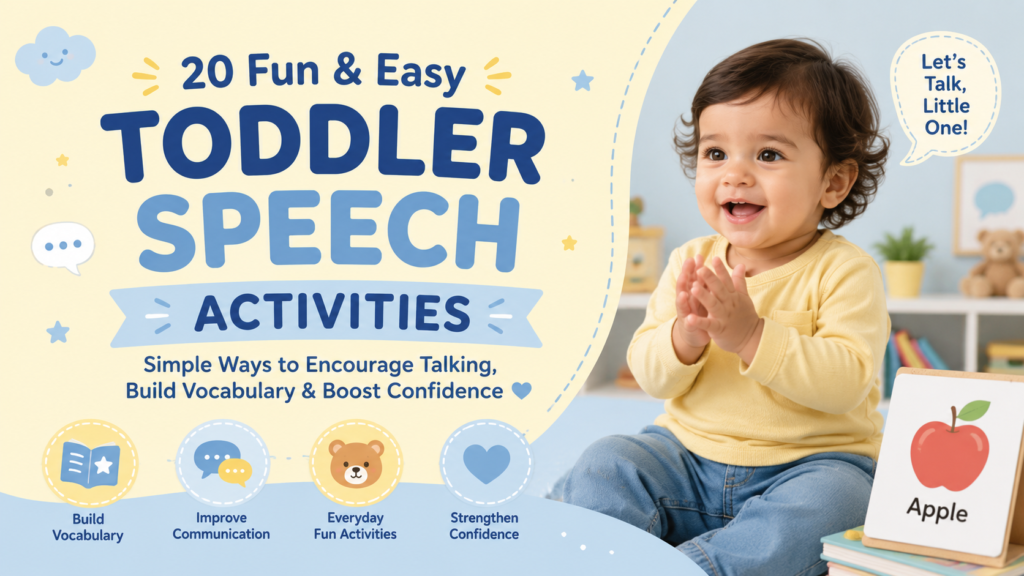
Watching your toddler say their first words is one of the most exciting milestones for parents. Whether it’s “mama,” “dada,” or pointing at a dog and saying “woof,” every new word is a huge step in language development.
The good news is that you don’t need flashcards, expensive educational toys, or long learning sessions to encourage speech. Toddlers learn best through everyday conversations, play, songs, books, and interaction with the people they love.
This guide shares simple toddler speech activities that fit naturally into your daily routine and help support vocabulary, listening skills, communication, and confidence.
Looking for more learning ideas? Read our guide on 12–18 Months Baby Activities.
Table of Contents
Why Toddler Speech Activities Matter
Between 12 and 24 months, your toddler’s brain develops rapidly. During this stage they are constantly listening, copying sounds, understanding words, and trying to communicate.
Speech activities help children:
- Build vocabulary
- Improve listening skills
- Understand simple instructions
- Increase confidence
- Strengthen memory
- Learn turn-taking
- Improve social interaction
- Express needs and feelings
Remember, every child develops differently. These activities support learning but should never feel like lessons.
How Toddlers Develop Speech Between 12 and 24 Months
Every toddler develops language skills at their own pace, but understanding what typically happens between 12 and 24 months can help parents set realistic expectations.
Around 12 months, many toddlers begin saying their first meaningful words, such as “mama,” “dada,” or the names of familiar objects. They also start responding to simple questions and recognizing common words used during daily routines.
Between 15 and 18 months, vocabulary usually grows steadily. Many toddlers begin pointing to objects when asked, following simple directions, and attempting to imitate new words they hear from parents and caregivers.
By 18 to 24 months, toddlers often start combining two simple words together, such as “more milk,” “bye daddy,” or “big ball.” Their understanding of language also improves rapidly, even if they are not speaking many words yet.
Remember that children understand many more words than they can actually say. Regular conversations, reading, singing, and play all help strengthen these early communication skills.
20 Fun & Easy Toddler Speech Activities
1. Read Books Every Day
Reading remains one of the best speech activities.
Choose books with:
- Bright pictures
- Animals
- Vehicles
- Everyday objects
- Simple repetitive text
Instead of rushing through the story, pause often.
Ask:
“What is this?”
“Can you find the cat?”
“What sound does the cow make?”
Even if your toddler cannot answer yet, they are learning.
2. Narrate Your Day
Talk about everything you’re doing.
Examples:
“I’m washing the apple.”
“Let’s put on your shoes.”
“The water is warm.”
“You’re drinking milk.”
Hearing language throughout the day teaches vocabulary naturally.
3. Sing Nursery Rhymes
Songs improve:
- Memory
- Rhythm
- Pronunciation
- Word recognition
Popular choices:
- Twinkle Twinkle
- Wheels on the Bus
- Old MacDonald
- If You’re Happy and You Know It
Pause before familiar words and let your toddler try filling them in.
4. Animal Sound Game
Toddlers usually imitate sounds before words.
Show animal pictures and ask:
“What does the cow say?”
“What sound does the dog make?”
Animal sounds strengthen speech muscles and confidence.
5. Point and Name Objects
Walk around your home together.
Point to objects:
- Chair
- Window
- Spoon
- Ball
- Cup
- Fan
Repeat names often without testing your child.
6. Bubble Time
Blowing bubbles naturally encourages communication.
Ask:
“More?”
“Pop!”
“Big bubble?”
This simple activity encourages eye contact and requesting.
7. Pretend Play
Use dolls, toy kitchens, toy phones or stuffed animals.
Pretend conversations teach:
- New words
- Emotions
- Conversation skills
- Imagination
8. Picture Matching Games
Use simple picture cards.
Match:
Animals
Foods
Clothes
Body parts
Vehicles
Talk about each picture while playing.
9. Follow Simple Directions
Ask your toddler to:
Bring the ball
Open the box
Close the door
Wave goodbye
Simple directions improve understanding before speech develops.
10. Mirror Play
Sit together in front of a mirror.
Practice:
Smiling
Blowing kisses
Making funny faces
Lip movements
This builds awareness of mouth movements used during speech.
11. Name Body Parts
During bath time or dressing say:
“Nose”
“Eyes”
“Hands”
“Feet”
Repeat often.
12. Snack Time Conversations
Instead of silently serving food:
“Banana?”
“Apple?”
“More?”
“All done?”
Meals create excellent language opportunities.
13. Toy Basket Surprise
Hide familiar toys inside a basket.
Let your toddler pull one out.
Name it together.
Describe:
Color
Size
Sound
Action
14. Music and Movement
Dance while naming actions.
Jump
Clap
Spin
Wave
Stop
Action words become easier to understand through movement.
15. Outdoor Nature Walks
Point out:
Bird
Tree
Flower
Car
Dog
Leaves
Nature provides endless vocabulary.
16. Build With Blocks
While stacking blocks say:
Up
Down
Big
Small
More
Again
Simple words repeated during play improve learning.
17. Use Everyday Routines
Speech practice doesn’t require special time.
Talk while:
- Cooking
- Cleaning
- Shopping
- Laundry
- Bath time
- Car rides
These conversations expose toddlers to thousands of words daily.
18. Limit Passive Screen Time
Children learn language through interaction—not just listening to screens.
If using educational videos, watch together and talk about what you see.
19. Expand Their Words
If your toddler says:
“Car”
You can respond:
“Yes! A big blue car.”
This naturally teaches longer sentences.
20. Celebrate Every Attempt
Don’t focus on perfect pronunciation.
Celebrate:
New sounds
Gestures
Single words
Attempts to communicate
Confidence grows when toddlers feel encouraged.
Everyday Moments That Help Toddlers Learn to Talk
Many parents think speech practice requires structured learning sessions, but the best opportunities happen naturally throughout the day.
During Meals
Talk about the food you’re serving.
- “This is a banana.”
- “The apple is red.”
- “Milk is cold.”
Encourage your toddler to point, choose, or repeat simple words without pressure.
During Bath Time
Bath time introduces plenty of vocabulary.
Talk about:
- Water
- Splash
- Wash
- Soap
- Bubbles
- Towel
These repeated words quickly become familiar.
During Grocery Shopping
Shopping is a wonderful language activity.
Point out:
- Fruits
- Vegetables
- Colors
- Animals on packaging
- Vehicles in the parking lot
Even a short shopping trip becomes a learning experience.
While Getting Dressed
Use clothing words daily.
Examples include:
- Shirt
- Socks
- Hat
- Shoes
- Blue
- Red
- Zip
- Button
Repeating these words every morning helps toddlers remember them naturally.
Best Toys That Encourage Speech Development
The best speech toys are often the simplest ones because they encourage interaction instead of passive play.
Great options include:
- Board books
- Wooden puzzles
- Stacking blocks
- Toy animals
- Toy kitchen sets
- Baby dolls
- Shape sorters
- Musical instruments
- Toy telephones
- Building blocks
Remember, it isn’t the toy itself that teaches language—it’s the conversations you have while playing together.
Signs Your Toddler’s Speech Is Progressing Well
Parents often wonder if their child’s speech development is on track. While every child grows at their own pace, these signs usually indicate healthy language development.
Your toddler may:
- Respond when you call their name.
- Make eye contact during conversations.
- Point to familiar objects.
- Follow simple instructions like “Bring me the ball.”
- Try to imitate words or sounds.
- Use gestures along with speech.
- Enjoy songs, rhymes, and storytime.
- Attempt to communicate even when words aren’t clear.
These milestones often show that your toddler is actively learning and developing communication skills.
Tips for Parents to Encourage More Talking
You don’t need to become a teacher to support your toddler’s speech. Small changes in everyday interactions can make a big difference.
- Speak slowly and clearly.
- Give your toddler enough time to respond.
- Listen patiently without interrupting.
- Expand on the words they already know.
- Read together every day, even if only for 10 minutes.
- Celebrate every attempt to communicate.
- Avoid correcting pronunciation constantly.
- Focus on conversation instead of testing your child.
Children learn language best when they feel relaxed, supported, and encouraged.
Speech Activities by Age
12–15 Months
- Peek-a-boo
- Animal sounds
- Naming family members
- Pointing to body parts
- Reading picture books
15–18 Months
- Bubble games
- Toy telephone conversations
- Simple matching games
- Singing nursery rhymes
- Pretend feeding dolls
18–24 Months
- Pretend grocery shopping
- Role-play games
- Color naming
- Simple puzzles
- Asking “Where is the ball?”
- Building blocks while describing actions
As your toddler grows, gradually introduce activities that encourage longer conversations and more complex vocabulary.
Common Speech Mistakes Parents Should Avoid
Avoid correcting every word.
Don’t compare your child to others.
Avoid asking too many test-like questions.
Don’t pressure your toddler to repeat everything.
Keep learning fun and playful.
When Should Parents Seek Professional Advice?
Every child develops differently, but consider speaking with your pediatrician or a speech-language pathologist if your toddler:
- Rarely babbles by 12 months
- Says very few words by 18 months
- Doesn’t respond to their name consistently
- Has difficulty understanding simple instructions
- Loses words they previously used
- Shows little interest in communicating
Early support can make a meaningful difference when concerns are identified.
Daily Speech Routine (10 Minutes)
Morning: Name clothes while dressing.
Breakfast: Talk about foods.
Afternoon: Read one book.
Evening: Sing songs together.
Bedtime: Describe the day’s activities.
Small daily conversations build strong language skills over time.
Final Thoughts
Speech development isn’t about teaching perfect words—it’s about creating opportunities to communicate every day. Reading together, singing songs, naming objects, playing pretend, and talking during everyday routines all help toddlers build vocabulary naturally.
Be patient, celebrate every small milestone, and remember that every child develops at their own pace. The most valuable speech activity is simply spending time talking, listening, and responding to your toddler with love and encouragement.
Frequently Asked Questions (FAQs)
1. What age should toddlers start talking?
Most toddlers say their first meaningful words around 12 months and gradually build vocabulary between 12 and 24 months.
2. What activities improve toddler speech?
Reading books, singing songs, pretend play, naming objects, animal sounds, and everyday conversations are some of the best speech-building activities.
3. Can screen time delay speech?
Too much passive screen time may reduce opportunities for real-life conversation. Interactive play and talking together are more beneficial for language development.
4. How often should I do toddler speech activities?
Short daily interactions are more effective than long sessions. Even 10–15 minutes of focused play and conversation can make a big difference.
5. Should I worry if my toddler isn’t talking much?
Every child develops at a different pace. If you’re concerned about your toddler’s speech or language development, speak with your pediatrician or a qualified speech-language pathologist.
Explore More By Categories
You may also like
- 20 Easy Baby Breakfast Ideas for 6–12 Months

- 200+ Vintage Baby Girl Names With Beautiful Meanings

- 30 Kids Party Food Ideas Everyone Will Love

- 100+ Vintage Baby Boy Names With Cool Meanings
- Storage Tips for Homemade Baby Food: A Safe & Easy Guide for Parents

- 100+ Cultural & Modern Dhanu Rashi Baby Boy Names With Wonderful Meanings