
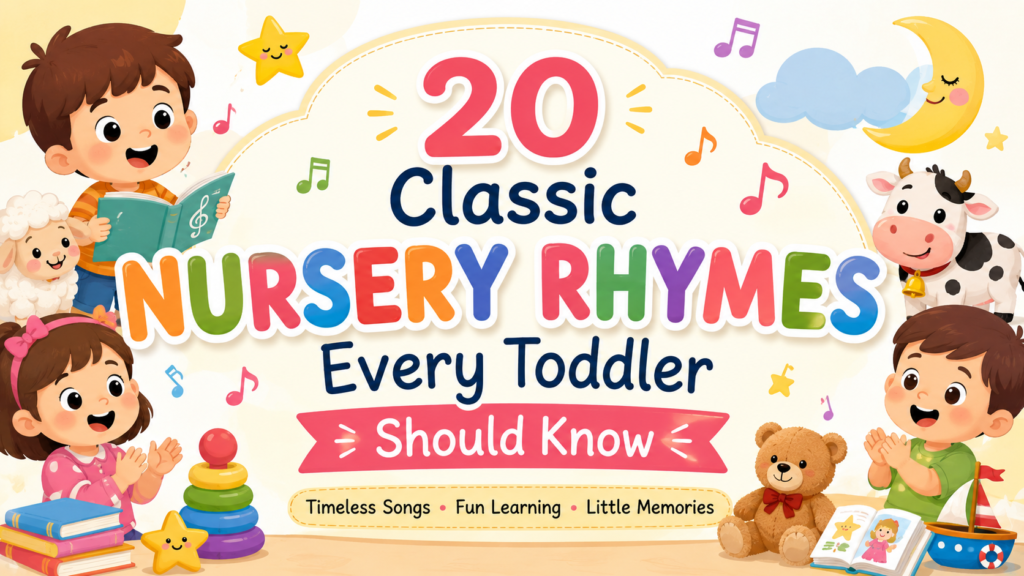
Nursery rhymes are one of the simplest ways to make learning fun for toddlers. From clapping along to “Pat-a-Cake” to pretending to be a little spider during “Itsy Bitsy Spider,” classic rhymes encourage children to listen, move, repeat words, and participate.
For toddlers, nursery rhymes are more than just songs. They can support early language development, memory, rhythm, coordination, vocabulary, and social interaction. Repeating familiar rhymes also gives little ones an opportunity to practice sounds and words in a fun, pressure-free way.
Whether you’re looking for songs for a toddler playtime routine, preschool activities, car rides, or a calming bedtime tradition, these 20 classic nursery rhymes are a wonderful place to start.
Lokking for the lunchbox ideas for your toddlers read this – 15 easy lunchbox ideas for picky eaters
Table of Contents
Why Are Nursery Rhymes Good for Toddlers?
Toddlers naturally enjoy repetition, rhythm, and predictable patterns. That’s exactly what makes nursery rhymes so engaging.
Regularly singing nursery rhymes with your child can encourage:
- Language development: Repeated words help toddlers hear and practice new sounds and vocabulary.
- Memory skills: Children learn to remember familiar sequences and phrases.
- Listening skills: Rhymes encourage children to listen carefully and anticipate what comes next.
- Early literacy: Rhyming words help children become aware of sounds in language.
- Movement and coordination: Action rhymes encourage clapping, jumping, pointing, and other movements.
- Confidence: Toddlers love being able to join in with familiar songs.
- Parent-child bonding: Singing together creates simple opportunities for connection and interaction.
You don’t need special toys or equipment. Your voice, hands, and a little imagination are enough to turn a nursery rhyme into a fun toddler activity.
20 Classic Nursery Rhymes for Toddlers
1. Twinkle, Twinkle, Little Star ⭐
Why toddlers love it:
The gentle melody and simple imagery make this a lovely rhyme for quiet time and bedtime.
Traditional public-domain text:
Twinkle, twinkle, little star,
How I wonder what you are!
Up above the world so high,
Like a diamond in the sky.When the blazing sun is gone,
When he nothing shines upon,
Then you show your little light,
Twinkle, twinkle, all the night.Then the traveller in the dark
Thanks you for your tiny spark;
He could not see which way to go,
If you did not twinkle so.In the dark blue sky you keep,
And often through my curtains peep,
For you never shut your eye,
Till the sun is in the sky.Twinkle, twinkle, little star,
How I wonder what you are!
Toddler activity: Ask your child to make star shapes with their hands and point toward the sky.
2. Mary Had a Little Lamb 🐑
This classic rhyme is wonderful for introducing toddlers to animals and repetition.
Traditional public-domain text:
Mary had a little lamb,
Its fleece was white as snow;
And everywhere that Mary went
The lamb was sure to go.It followed her to school one day,
Which was against the rule;
It made the children laugh and play
To see a lamb at school.And so the teacher turned it out,
But still it lingered near,
And waited patiently about
Till Mary did appear.“Why does the lamb love Mary so?”
The little children cry;
“Why, Mary loves the lamb, you know,”
The teacher did reply.
Toddler activity: Pretend to walk like a lamb while repeating “Mary” and “lamb.”
3. Baa, Baa, Black Sheep 🐑
This short rhyme is easy for toddlers to remember and introduces simple questions and answers.
Traditional public-domain text:
Baa, baa, black sheep,
Have you any wool?
Yes sir, yes sir,
Three bags full.One for my master,
And one for my dame,
And one for the little boy
Who lives down the lane.
Toddler activity: Show your child pictures of sheep and talk about wool and where it comes from.
4. Humpty Dumpty 🥚
Humpty Dumpty is a short, memorable rhyme with a fun character toddlers can easily visualize.
Traditional public-domain text:
Humpty Dumpty sat on a wall,
Humpty Dumpty had a great fall;
All the king’s horses,
And all the king’s men,
Couldn’t put Humpty together again.
Toddler activity: Use an egg-shaped paper cutout and let your toddler decorate their own Humpty Dumpty.
5. Jack and Jill ⛰️
This classic rhyme is useful for practicing names, simple actions, and sequencing.
Traditional public-domain text:
Jack and Jill went up the hill
To fetch a pail of water;
Jack fell down and broke his crown,
And Jill came tumbling after.Up Jack got, and home did trot,
As fast as he could caper;
He went to bed to mend his head
With vinegar and brown paper.
Toddler activity: Have your toddler pretend to climb a hill, fall down safely, and get back up.
6. Row, Row, Row Your Boat 🚣
The repetitive rhythm makes this rhyme especially fun for group singing.
Traditional public-domain text:
Row, row, row your boat
Gently down the stream;
Merrily, merrily, merrily, merrily,
Life is but a dream.
Toddler activity: Sit facing your child and gently rock backward and forward as though you’re rowing a boat.
7. Itsy Bitsy Spider 🕷️
This is one of the best action rhymes for toddlers because the hand movements are easy to imitate.
Traditional public-domain text:
The itsy bitsy spider
Climbed up the water spout.
Down came the rain
And washed the spider out.Out came the sunshine
And dried up all the rain,
And the itsy bitsy spider
Climbed up the spout again.
Toddler activity: Use your fingers to imitate the spider climbing, rain falling, and sunshine appearing.
8. Hickory Dickory Dock 🕰️
This rhyme introduces children to clocks, numbers, and time-related vocabulary.
Traditional public-domain text:
Hickory, dickory, dock,
The mouse ran up the clock;
The clock struck one,
The mouse ran down,
Hickory, dickory, dock.
Toddler activity: Make a pretend clock using a paper plate and move the hands while saying the rhyme.
9. Hey Diddle Diddle 🌙
The silly images in this rhyme can encourage imagination and conversation.
Traditional public-domain text:
Hey diddle diddle,
The cat and the fiddle,
The cow jumped over the moon;
The little dog laughed
To see such sport,
And the dish ran away with the spoon.
Toddler activity: Ask your child, “Can a cow really jump over the moon?” Use the rhyme to encourage imaginative play.
10. Little Bo-Peep 🐑
This classic rhyme gives toddlers an opportunity to learn about animals and simple storytelling.
Traditional public-domain text:
Little Bo-Peep has lost her sheep,
And can’t tell where to find them;
Leave them alone, and they’ll come home,
Wagging their tails behind them.
Toddler activity: Hide a few toy animals around the room and let your toddler play “find the sheep.”
11. Little Miss Muffet 🕷️
A short rhyme with a memorable character, food, and spider makes this an entertaining choice for toddlers.
Traditional public-domain text:
Little Miss Muffet
Sat on a tuffet,
Eating her curds and whey;
There came a big spider
And sat down beside her
And frightened Miss Muffet away.
Toddler activity: Talk about how Miss Muffet might have felt when she saw the spider. This can also become a simple emotions activity.
12. Pat-a-Cake 🎂
This is a wonderful interactive rhyme for parent-child play.
Traditional public-domain text:
Pat-a-cake, pat-a-cake, baker’s man,
Bake me a cake as fast as you can;
Pat it and prick it and mark it with B,
And put it in the oven for baby and me.
Toddler activity: Clap your hands together and pretend to mix, roll, and bake a cake.
13. Rain, Rain, Go Away 🌧️
This short rhyme is easy for toddlers to repeat and works especially well during rainy-day play.
Traditional public-domain text:
Rain, rain, go away,
Come again another day;
Little children want to play.
Toddler activity: Let your child draw a picture of rain, clouds, and sunshine.
14. London Bridge Is Falling Down 🌉
This rhyme is perfect for movement and group play.
Traditional public-domain text:
London Bridge is falling down,
Falling down, falling down,
London Bridge is falling down,
My fair lady.
Toddler activity: Hold your arms together with another person to create a bridge and let your toddler walk underneath.
15. Rock-a-Bye Baby 🌙
The gentle rhythm of this traditional lullaby makes it suitable for quiet moments and bedtime.
Traditional public-domain text:
Rock-a-bye baby, on the tree top,
When the wind blows, the cradle will rock;
When the bough breaks, the cradle will fall,
Down will come baby, cradle and all.
Toddler activity: Sing it softly as part of your bedtime routine. For very young children, use safe, stationary seating or a crib rather than actually rocking them in an unsafe place.
16. Three Blind Mice 🐭
This simple rhyme has repetition that makes it easy for young children to participate.
Traditional public-domain text:
Three blind mice,
Three blind mice,
See how they run,
See how they run!They all ran after the farmer’s wife,
Who cut off their tails
With a carving knife,
Did you ever see such a thing in your life
As three blind mice?
Toddler activity: For toddlers, you can simply focus on the first four lines and have them pretend to run like little mice.
17. Old MacDonald Had a Farm 🐄
This traditional children’s song is especially useful for teaching animal names and sounds.
Common traditional version:
Old MacDonald had a farm,
E-I-E-I-O,
And on his farm he had a cow,
E-I-E-I-O,
With a moo-moo here,
And a moo-moo there,
Here a moo, there a moo,
Everywhere a moo-moo,
Old MacDonald had a farm,
E-I-E-I-O.
You can replace “cow” with other animals such as a duck, pig, horse, sheep, or chicken.
Toddler activity: Ask your child to make each animal sound.
18. One, Two, Buckle My Shoe 👟
This rhyme is a playful way to introduce numbers and simple daily routines.
Traditional public-domain text:
One, two,
Buckle my shoe;
Three, four,
Knock at the door;
Five, six,
Pick up sticks;
Seven, eight,
Lay them straight;
Nine, ten,
A big fat hen.
Toddler activity: Count everyday objects together while saying the numbers.
19. Polly Put the Kettle On 🫖
This traditional rhyme is short and repetitive, making it easy for toddlers to join in.
Traditional public-domain text:
Polly, put the kettle on,
We’ll all have tea;
Sukey, take it off again,
They’ve all gone away.
Toddler activity: Set up a pretend tea party using toy cups and plates. Let your toddler practice pouring pretend tea.
20. Sing a Song of Sixpence 🐦
This traditional nursery rhyme introduces children to rhyme, rhythm, and imaginative storytelling.
Traditional public-domain text:
Sing a song of sixpence,
A pocket full of rye,
Four and twenty blackbirds
Baked in a pie.When the pie was opened,
The birds began to sing;
Wasn’t that a dainty dish
To set before the king?The king was in his counting-house
Counting out his money;
The queen was in the parlour
Eating bread and honey.The maid was in the garden
Hanging out the clothes,
When down came a blackbird
And pecked off her nose.
Toddler activity: Keep the activity light and imaginative by pretending to be birds singing in a garden.
How to Make Nursery Rhymes More Educational
You don’t have to simply sing the rhyme from beginning to end. Turn it into a mini learning activity.
1. Add Actions
Use hand movements, clapping, jumping, spinning, or marching. Action songs help toddlers connect language with movement.
2. Use Props
Try puppets, stuffed animals, paper cutouts, scarves, toy food, or homemade props.
For example:
- Spider puppet for “Itsy Bitsy Spider”
- Sheep toy for “Little Bo-Peep”
- Paper stars for “Twinkle, Twinkle”
- Toy animals for “Old MacDonald”
3. Practice New Words
Choose one or two words from each rhyme and explain them simply.
For example:
“Twinkle, Twinkle” → star, sky, diamond
“Old MacDonald” → farm, cow, sheep
“Hickory Dickory Dock” → mouse, clock, one
4. Encourage Your Toddler to Finish the Line
Pause before a familiar word.
For example:
“Twinkle, twinkle, little ____.”
Give your toddler a chance to say “star!”
This can help build listening and recall skills.
5. Create a Nursery Rhyme Basket
Put a few simple objects into a basket and use them during rhyme time.
For example, your basket might contain:
- A toy spider
- A toy sheep
- A small toy boat
- A star cutout
- A toy clock
Let your toddler pick an object and choose the corresponding rhyme.
When Is the Best Time to Sing Nursery Rhymes?
Nursery rhymes can fit into almost any part of your toddler’s day.
☀️ Morning
Start the day with energetic action songs and movement rhymes.
🍽️ Mealtime
Short rhymes can be a fun way to keep toddlers engaged while waiting for food.
🚗 Travel Time
Sing familiar rhymes during car rides instead of relying entirely on screens.
🧸 Playtime
Use puppets, toys, and movement to turn nursery rhymes into pretend play.
🌙 Bedtime
Choose gentle rhymes such as “Twinkle, Twinkle, Little Star” or traditional lullabies for a calming routine.
How Many Nursery Rhymes Should a Toddler Learn?
There is no specific number that every toddler needs to know. The goal isn’t to memorize a certain number of songs.
Instead, focus on repetition and enjoyment.
A toddler may want to hear the same rhyme every day for weeks. That’s completely normal. Repetition is actually helpful because children become familiar with the words, sounds, rhythm, and sequence.
You can start with five favorites and gradually introduce new ones.
For example:
Week 1: Twinkle, Twinkle + Itsy Bitsy Spider
Week 2: Add Mary Had a Little Lamb + Old MacDonald
Week 3: Add Row, Row, Row Your Boat + Pat-a-Cake
Week 4: Add Humpty Dumpty + Hickory Dickory Dock
Before long, your toddler may have a whole collection of favorite nursery rhymes.
Final Thoughts
Classic nursery rhymes have been entertaining children for generations, and they’re still a wonderful addition to a toddler’s daily routine.
Whether you’re singing “Itsy Bitsy Spider” while getting dressed, playing “Old MacDonald” with animal toys, or winding down with “Twinkle, Twinkle, Little Star,” these simple songs create opportunities for learning through play.
The best part? You don’t need expensive toys, complicated activities, or a perfect singing voice. Your toddler simply needs your time, your voice, and plenty of opportunities to join in.
Pick a few rhymes from this list, repeat them often, add simple actions, and let your toddler have fun. 🎵💛
FAQs
1. What are the best nursery rhymes for toddlers?
Some great choices include Twinkle, Twinkle, Little Star, Itsy Bitsy Spider, Mary Had a Little Lamb, Old MacDonald Had a Farm, Row, Row, Row Your Boat, Humpty Dumpty, and Pat-a-Cake. Choose rhymes with simple words, repetition, and actions your toddler can follow.
2. How do nursery rhymes help toddlers learn?
Nursery rhymes can support early language, listening, memory, vocabulary, rhythm, and sound awareness. Action rhymes can also encourage movement and coordination.
3. What age should children start listening to nursery rhymes?
You can introduce nursery rhymes from infancy. Babies may enjoy the rhythm and your voice, while toddlers can gradually participate by making sounds, doing actions, and repeating words.
4. How can I make nursery rhymes more fun for my toddler?
Add hand movements, dancing, puppets, stuffed animals, props, or simple crafts. You can also pause before familiar words and let your toddler complete the line.
5. What nursery rhymes are good for learning numbers?
One, Two, Buckle My Shoe is a good starting point for number practice. Hickory Dickory Dock can also be used for introducing clocks and counting.
6. Which nursery rhymes are good for bedtime?
Gentle rhymes and lullabies such as Twinkle, Twinkle, Little Star and Rock-a-Bye Baby can be included in a calming bedtime routine.
7. Can nursery rhymes help with speech development?
Rhymes provide opportunities for children to hear repeated sounds, words, and sentence patterns. Singing together also encourages toddlers to practice making sounds and saying familiar words.
8. Should toddlers watch nursery rhymes on YouTube?
Parents can choose age-appropriate videos, but nursery rhymes don’t have to involve screens. Singing together, using toys, and acting out rhymes can make them interactive and screen-free.
9. How often should I sing nursery rhymes with my toddler?
There is no required schedule. Even a few minutes of singing each day can become a fun part of your child’s routine. Repeating favorite rhymes is perfectly fine.
10. What is the best way to teach nursery rhymes to toddlers?
Start with a few short, repetitive rhymes. Sing them regularly, use simple actions, and encourage your toddler to participate rather than expecting them to memorize every word.
Explore More By Categories
- Baby care tips
- Baby Essentials
- Baby Feeding Guide
- Baby Names
- Healthy Racipe for mom
- Kids Birthday Ideas
- Kids Meal Ideas & Food Recipes
- Kids Songs, Rhymes & Stories
- Postpartum Care
- Toddler Learning & Daily Skills
Related Reads for Mom
- Storage Tips for Homemade Baby Food: A Safe & Easy Guide for Parents

- 100+ Cultural & Modern Dhanu Rashi Baby Boy Names With Wonderful Meanings
- 20 Classic Nursery Rhymes For Toddlers : Every Toddler Should Know
- 35 Fun Rainy Day Activities for Toddlers to Keep Them Busy & Learning
- 100+ Cultural and Religious Dhanu (Sagittarius) Rashi Baby Girl Names With Meanings
- 15 Easy Lunchbox Ideas for Picky Eaters That Kids Will Actually Eat