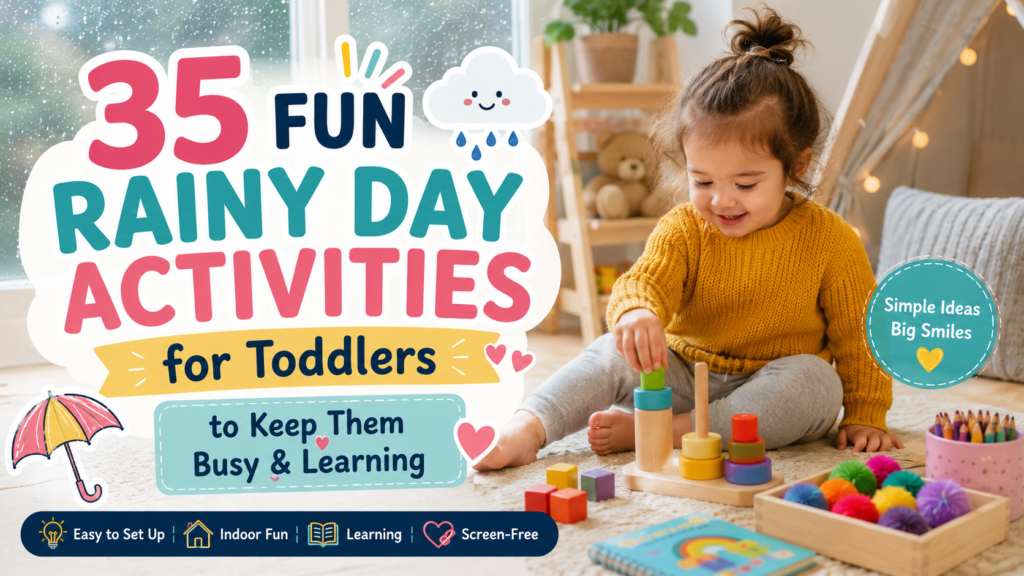
Rainy days can be challenging when you have an energetic toddler at home. When outdoor play is off the table, little ones can quickly become bored, restless, or ready to climb everything in sight! But a rainy day can also be a wonderful opportunity to slow down, play together, and introduce simple learning activities at home.
You don’t need expensive toys or complicated craft supplies to keep your toddler entertained. Many of the best rainy day activities for toddlers use things you already have around the house. From easy counting games and sensory play to indoor obstacle courses, crafts, pretend play, and practical life activities, there are plenty of ways to make a rainy afternoon fun and meaningful.
The activities below are designed to help toddlers develop important skills while they play, including fine motor skills, language, early math, creativity, problem-solving, coordination, independence, and social-emotional skills.
So the next time rain keeps your little one indoors, try one of these 35 fun indoor activities for toddlers!
Table of Contents
Wants to know about Speech Activities for Toddler’s read our – 20 Best Toddler Speech Activities That Actually Boost Talking (12–24 Months)
35 Fun Rainy Day Activities for Toddlers
1. Create a Color Sorting Game
Color sorting is a simple activity that can turn everyday toys into a learning game.
Collect objects in different colors, such as blocks, toy cars, balls, socks, or plastic cups. Place a few colored containers on the floor and ask your toddler to put each object into the matching container.
Start with two or three colors and gradually add more as your toddler becomes comfortable.
Skills developed: Color recognition, sorting, concentration, and early thinking skills.
2. Try a 5-Minute Counting Game
You don’t need worksheets to introduce early math concepts. Gather pom-poms, blocks, toy animals, or other safe objects and ask your toddler to count them.
For example, place five blocks in front of your child and count them together. You can then ask, “Can you give me three blocks?”
Keep the activity short and playful.
Skills developed: Counting, number recognition, one-to-one correspondence, and memory.
3. Go on an Alphabet Hunt
Turn your home into a mini alphabet adventure.
Write a few large letters on paper and place them around a room. Ask your toddler to find a particular letter. You can also pair letters with familiar objects—for example, “A is for apple.”
Don’t worry about teaching the entire alphabet in one session. Choose just a few letters and repeat them regularly.
Skills developed: Letter recognition, memory, vocabulary, and listening.
4. Have a Shape Hunt
Ask your toddler to find different shapes around your home.
“Can you find something round?”
“Can you find a rectangle?”
Look for everyday examples such as plates, windows, books, doors, clocks, and cushions.
This activity helps children understand that shapes aren’t only pictures on flashcards—they exist everywhere around them.
Skills developed: Shape recognition, observation, vocabulary, and problem-solving.
5. Play a Simple Matching Game
Make your own matching game using paper cards.
Draw or print simple pictures and create two cards for each item. Place them face up initially and ask your toddler to find matching pairs.
For younger toddlers, use just two or three pairs. Increase the number as they become more confident.
Skills developed: Memory, visual discrimination, concentration, and problem-solving.
6. Pom-Pom Transfer Activity
This is an excellent fine motor activity for toddlers.
Place large pom-poms in a bowl and provide another empty container. Your toddler can use child-safe tongs or a spoon to transfer the pom-poms from one container to another.
You can make it more challenging by asking them to sort the pom-poms by color.
Skills developed: Hand-eye coordination, fine motor control, concentration, and hand strength.
Safety note: Always supervise closely and choose materials appropriate for your child’s age. Small objects can be choking hazards.
7. Have Fun With Stickers
Give your toddler a sheet of large stickers and some paper.
They can stick them randomly, create a picture, or follow a simple pattern. You can also draw circles on paper and ask your child to place stickers inside them.
This activity is simple, inexpensive, and surprisingly engaging.
Skills developed: Fine motor skills, hand-eye coordination, creativity, and concentration.
8. Play With Playdough
Playdough provides endless opportunities for toddler learning.
Ask your child to make balls, snakes, flowers, pretend food, or simple shapes. You can also introduce colors and counting by asking questions such as, “Can you make three little balls?”
Let your toddler explore without worrying about making perfect shapes.
Skills developed: Hand strength, creativity, fine motor skills, imagination, and early math.
9. Make a Paper Collage
Give your toddler pieces of colored paper and a large sheet of paper.
Let them tear, arrange, and glue the paper pieces to create a collage. You can make a theme such as a rainy-day picture, garden, house, or rainbow.
Toddlers don’t need to create a recognizable picture for the activity to be valuable.
Skills developed: Fine motor skills, creativity, coordination, and decision-making.
10. Set Up an Indoor Water Play Station
If you have a suitable space, create a small water play station using a shallow container, cups, spoons, and waterproof toys.
Your toddler can scoop, pour, fill, and empty containers.
Keep the setup simple and supervise continuously around water.
Skills developed: Hand-eye coordination, early science concepts, sensory exploration, and motor skills.
11. Create a Simple Sensory Bin
Fill a container with a safe, age-appropriate sensory material and add large scoops, cups, and toys.
You can create themes such as animals, colors, or vehicles.
Sensory bins encourage children to touch, scoop, pour, explore, and experiment.
Skills developed: Sensory processing, fine motor skills, language, and concentration.
12. Explore Ice Cubes
Place a few ice cubes in a bowl and let your toddler observe what happens as they melt.
Talk about what they feel like and what happens when they become water.
You can ask:
“Is the ice cold?”
“What happens when it melts?”
“Where did the ice go?”
Skills developed: Observation, sensory awareness, vocabulary, and early science concepts.
13. Make a Sensory Bottle
A sensory bottle can provide a calming activity for toddlers.
Use a sturdy, securely sealed bottle filled with safe materials such as water and large visual elements appropriate for the child’s age.
Let your toddler shake it, roll it, and watch what happens.
Make sure the container is securely closed and inspect it regularly.
Skills developed: Visual tracking, observation, curiosity, and sensory exploration.
14. Try Finger Painting
Rainy days are perfect for indoor creativity.
Put washable, child-safe paint on paper and let your toddler explore using their fingers. Talk about the colors while they paint.
You can say, “You’re using blue!” or “What happens when we mix yellow and red?”
Skills developed: Creativity, sensory awareness, color recognition, and fine motor development.
15. Try Sponge Painting
If finger painting feels too messy, sponge painting is another fun option.
Cut large sponges into simple shapes and let your toddler dip them into washable paint before stamping them onto paper.
Create flowers, clouds, houses, or abstract patterns.
Skills developed: Hand control, creativity, pattern recognition, and coordination.
16. Make a Paper Plate Craft
Paper plates can become almost anything.
Turn one into a lion, fish, sun, cloud, or animal. Let your toddler choose the colors and help with simple steps.
Remember that the goal is the process rather than a perfect finished craft.
Skills developed: Creativity, imagination, fine motor skills, and following simple instructions.
17. Have a Freeze Dance Party
Turn on some kid-friendly music and let your toddler dance.
When the music stops, everyone freezes!
You can make it even more fun by adding movements such as jumping, spinning, clapping, or stomping.
Skills developed: Gross motor skills, listening, balance, body awareness, and self-control.
18. Build an Indoor Obstacle Course
Use cushions, pillows, tunnels, and other safe household items to create a simple obstacle course.
Your toddler can crawl under a chair, walk around cushions, step over a soft pillow, and reach a finish line.
Keep everything stable and remove anything that could cause a fall.
Skills developed: Balance, coordination, gross motor skills, spatial awareness, and confidence.
19. Play Animal Walks
Pretend to be different animals around the house.
Can your toddler hop like a frog? Crawl like a bear? Waddle like a penguin?
Take turns choosing animals.
This activity requires almost no preparation and can help burn some indoor energy.
Skills developed: Gross motor skills, imagination, coordination, and language.
20. Play Follow-the-Leader
Take turns being the leader.
The leader can clap, jump, march, spin, touch their toes, or make funny movements. Your toddler tries to copy.
Then let your child become the leader.
Skills developed: Listening, memory, coordination, confidence, and social skills.
21. Read a Picture Book Together
A rainy day is a perfect excuse for extra story time.
Choose a picture book and encourage your toddler to point to objects and characters. Ask simple questions:
“What is that?”
“Where is the dog?”
“What color is the ball?”
“What do you think happens next?”
Skills developed: Vocabulary, listening, comprehension, imagination, and early literacy.
22. Try a Picture-Talking Activity
You don’t even need a book for this activity.
Choose a picture from a magazine, book, or homemade picture card and talk about it with your toddler.
Ask questions such as:
“What do you see?”
“What is the child doing?”
“What color is the car?”
“Where is the dog?”
Encourage your child to answer using words or short sentences.
Skills developed: Speech, vocabulary, communication, listening, and observation.
23. Complete an Age-Appropriate Puzzle
Puzzles are excellent for quiet indoor play.
Start with simple puzzles containing large pieces. Let your toddler experiment rather than immediately showing them where every piece goes.
Offer hints when needed.
Skills developed: Problem-solving, visual perception, concentration, and fine motor skills.
24. Create a Busy Basket
Put a few safe, age-appropriate activities into a basket.
You might include board books, chunky puzzles, large blocks, crayons, paper, or other favorite activities.
Bring the basket out when your toddler needs a change of activity.
Skills developed: Independent play, decision-making, concentration, and creativity.
25. Build With Blocks
Blocks are one of the simplest and most versatile toddler toys.
Challenge your child to build a tower, bridge, house, or road. Count the blocks together as you build.
When the tower falls, that’s part of the fun!
Skills developed: Fine motor skills, spatial awareness, creativity, balance, and early math.
26. Sort Toys by Category
Turn clean-up time into a learning game.
Ask your toddler to put animals together, cars together, blocks together, and dolls together.
You can also sort toys by color or size.
Skills developed: Categorization, vocabulary, organization, and logical thinking.
27. Have a Pretend Grocery Store
Set up a pretend grocery store using toy food or safe household items.
Give your toddler a small basket and ask them to “shop” for different items.
You can pretend to be the cashier and practice simple conversations.
Skills developed: Language, imagination, social skills, counting, and everyday-life understanding.
28. Let Your Toddler Help With Laundry
Toddlers often love helping with real household tasks.
Give your child simple jobs such as matching socks, putting clothes into a basket, or sorting clothing by type.
Make it playful and don’t worry about perfect results.
Skills developed: Independence, sorting, coordination, responsibility, and practical life skills.
29. Practice Getting Dressed
Use rainy-day indoor time to practice dressing skills.
Let your toddler try putting on socks, shoes, a jacket, or simple clothing.
Give them plenty of time and encourage their attempts instead of taking over immediately.
Skills developed: Independence, coordination, fine motor skills, and self-confidence.
30. Wash Toys
Set up a small washing station with appropriate waterproof toys, a cloth, and a little water.
Your toddler can wipe and rinse the toys.
This can turn a simple chore into a sensory and practical-life activity.
Skills developed: Fine motor skills, independence, pretend play, and responsibility.
31. Make a Simple Snack Together
Toddlers can participate in age-appropriate food preparation with close adult supervision.
They might wash fruit, place prepared pieces into a bowl, stir ingredients, or help spread something with a suitable utensil.
Talk about colors, textures, shapes, and quantities as you work.
Skills developed: Practical life skills, language, coordination, and independence.
32. Create a Rainy-Day Pretend Play Game
Since you can’t go outside, pretend you are exploring the rain!
Use umbrellas, stuffed animals, toy cars, or pretend rain boots to create a little indoor story.
You can say, “The rain is falling! Where should we go?”
Let your toddler take the story in their own direction.
Skills developed: Imagination, language, creativity, and emotional expression.
33. Make a Homemade Musical Instrument
Create simple instruments using safe household items.
For example, a securely closed container can become a shaker when filled with appropriate materials.
Sing songs together and let your toddler make rhythms.
Always ensure any homemade instrument is securely sealed and contains no accessible small parts.
Skills developed: Rhythm, listening, coordination, creativity, and language.
34. Play a Simple Treasure Hunt
Hide a few large, safe objects around one room.
Give your toddler clues such as:
“Can you find the red ball?”
“Can you find the teddy bear?”
“Look near the chair!”
For younger toddlers, keep the hiding places obvious.
Skills developed: Listening, memory, vocabulary, movement, and problem-solving.
35. Have a Cozy Independent Play Session
Not every rainy day activities for toddlers need to be structured.
Create a comfortable, safe play area and let your toddler choose between a few activities such as blocks, books, pretend play, or puzzles.
Independent play gives children an opportunity to explore their interests and practice entertaining themselves.
Stay nearby and supervise as appropriate, but allow your child some space to lead the play.
Skills developed: Creativity, independence, decision-making, concentration, and self-directed play.
How to Make Rainy Days Easier With a Toddler
You don’t need to entertain your toddler every minute of the day. A mixture of structured activities, free play, quiet time, and everyday tasks can make rainy days much easier.
Here are a few simple tips:
Keep Activities Short
Toddlers naturally have short attention spans. An activity doesn’t need to last 30 minutes to be valuable. Even five or ten minutes of focused play can be meaningful.
Rotate Activities
Instead of putting every toy and activity out at once, keep some items stored away and rotate them throughout the day.
A familiar toy can feel exciting again when your toddler hasn’t seen it for a few days.
Use Everyday Items
You don’t need to buy special educational materials. Cups, cardboard boxes, socks, blocks, paper, kitchen utensils, and household objects can become learning tools.
Mix Active and Quiet Play
If your toddler has lots of energy, start with dancing, animal walks, or an obstacle course. Follow that with a book, puzzle, or sensory activity.
Follow Your Toddler’s Interests
If your child loves animals, use animals in your counting, sorting, storytelling, and pretend-play activities.
When an activity connects with something your toddler already enjoys, they’re more likely to stay engaged.
Don’t Aim for Perfect
A toddler’s version of a craft may look completely different from the example you had in mind—and that’s okay!
The goal is exploration, connection, practice, and fun.
Why Indoor Play Is Important for Toddlers
Indoor play isn’t simply a way to keep children occupied when the weather is bad. Everyday play gives toddlers opportunities to practice important developmental skills.
Building blocks can support fine motor skills and spatial awareness. Counting games introduce early math concepts. Picture books build vocabulary. Sensory play encourages exploration. Pretend play supports imagination and language.
Most importantly, playing together gives you opportunities to talk, listen, respond, and connect with your child.
You don’t need to turn every activity into a lesson. Toddlers learn naturally through play, especially when adults give them opportunities to explore and participate.
A Simple Rainy-Day Activity Schedule
If you’re wondering how to fit several activities into one rainy day, here’s an easy example:
Morning:
Start with a picture book, followed by a 5-minute counting game.
Mid-morning:
Try a fine motor activity such as pom-pom transferring or playdough.
Before lunch:
Have an indoor movement activity such as freeze dance or an obstacle course.
Afternoon:
Set up a sensory bin, puzzle, or creative activity.
Late afternoon:
Let your toddler help with a practical task such as toy washing, laundry sorting, or snack preparation.
Evening:
Finish the day with quiet play, books, songs, and cuddles.
Remember, this is only an example. Follow your toddler’s mood, energy level, and interests.
Final Thoughts
Rainy days don’t have to mean endless screen time or a bored toddler. With a little creativity, your home can become a place for learning, movement, imagination, and discovery.
From 5-minute counting games and alphabet hunts to sensory bins, crafts, dancing, pretend play, and practical life activities, these rainy-day activities for toddlers can help keep little hands and minds engaged.
The best part is that many of these activities require little preparation and use things you already have at home.
So the next time dark clouds roll in, don’t worry about keeping your toddler entertained all day. Pick one simple activity, get down on the floor, and enjoy learning and playing together.
Sometimes, the simplest rainy-day moments become the most memorable ones. 💛
Save this list for the next rainy day and come back whenever you need an easy toddler activity idea!
❓ Frequently Asked Questions
1. What are the best rainy day activities for toddlers?
Some of the best rainy day activities for toddlers include indoor obstacle courses, sensory bins, counting games, alphabet hunts, playdough, puzzles, building blocks, pretend play, crafts, dancing, and picture-book activities. Choose activities based on your toddler’s age, interests, and attention span.
2. How do I keep my toddler busy on a rainy day?
Try rotating different types of activities throughout the day. Combine active play, such as dancing or an indoor obstacle course, with quieter activities like puzzles, books, sensory play, or coloring. You can also involve your toddler in simple household tasks such as sorting laundry or washing toys.
3. What are some easy indoor activities for toddlers?
Easy indoor activities include color sorting, counting games, sticker activities, playdough, building blocks, picture books, matching games, drawing, pretend play, and simple treasure hunts. Most require little preparation and can be done with everyday household items.
4. What are some screen-free rainy day activities for toddlers?
Try reading books, building with blocks, sensory play, puzzles, dancing, pretend play, drawing, crafts, sorting games, indoor treasure hunts, and practical life activities. These activities can keep toddlers engaged without relying on screens.
5. How can rainy day activities help toddlers learn?
Play gives toddlers opportunities to practice important developmental skills naturally. Counting games can introduce early math, puzzles encourage problem-solving, crafts develop fine motor skills, picture activities support language development, and movement games help build coordination and balance.
6. What can I do with my 2-year-old on a rainy day?
A 2-year-old can enjoy simple activities such as playdough, block building, color sorting, sticker art, dancing, picture books, sensory play, toy washing, pretend play, and supervised indoor movement games. Keep activities short and allow plenty of free play between structured activities.
7. How long should a toddler activity last?
There is no fixed amount of time an activity needs to last. Toddlers often have short attention spans, so even 5–15 minutes of focused play can be valuable. If your child loses interest, move on to another activity rather than forcing them to continue.
8. Do I need special supplies for rainy day toddler activities?
No. Many activities can be created using everyday items such as paper, cups, cardboard boxes, blocks, socks, books, kitchen utensils, and toys. Simple activities often provide just as many opportunities for learning and exploration as expensive activity kits.
9. How can I make indoor activities educational?
You can add simple learning opportunities to almost any activity. Count blocks while building, name colors while sorting, ask questions during pretend play, identify shapes around the house, or talk about pictures while reading. The goal is to make learning feel like play rather than a lesson.
10. Are sensory activities safe for toddlers?
Sensory activities should always be age-appropriate and supervised. Avoid materials that could be choking hazards, especially for younger toddlers, and never leave a child unattended around water or other potentially unsafe materials. Choose large, child-safe materials and follow appropriate supervision for your child’s age.
Explore More By Categories
- Baby care tips
- Baby Essentials
- Baby Feeding Guide
- Baby Names
- Healthy Racipe for mom
- Kids Birthday Ideas
- Kids Meal Ideas & Food Recipes
- Kids Songs, Rhymes & Stories
- Postpartum Care
- Toddler Learning & Daily Skills
Related Reads for Moms
- Storage Tips for Homemade Baby Food: A Safe & Easy Guide for Parents

- 100+ Cultural & Modern Dhanu Rashi Baby Boy Names With Wonderful Meanings

- 20 Classic Nursery Rhymes For Toddlers : Every Toddler Should Know
- 35 Fun Rainy Day Activities for Toddlers to Keep Them Busy & Learning
- 100+ Cultural and Religious Dhanu (Sagittarius) Rashi Baby Girl Names With Meanings
- 15 Easy Lunchbox Ideas for Picky Eaters That Kids Will Actually Eat